
Showing posts with label Maps-Graphs. Show all posts
Showing posts with label Maps-Graphs. Show all posts
2014-01-09
All the >1 km diameter objects of the Solar System in a single image
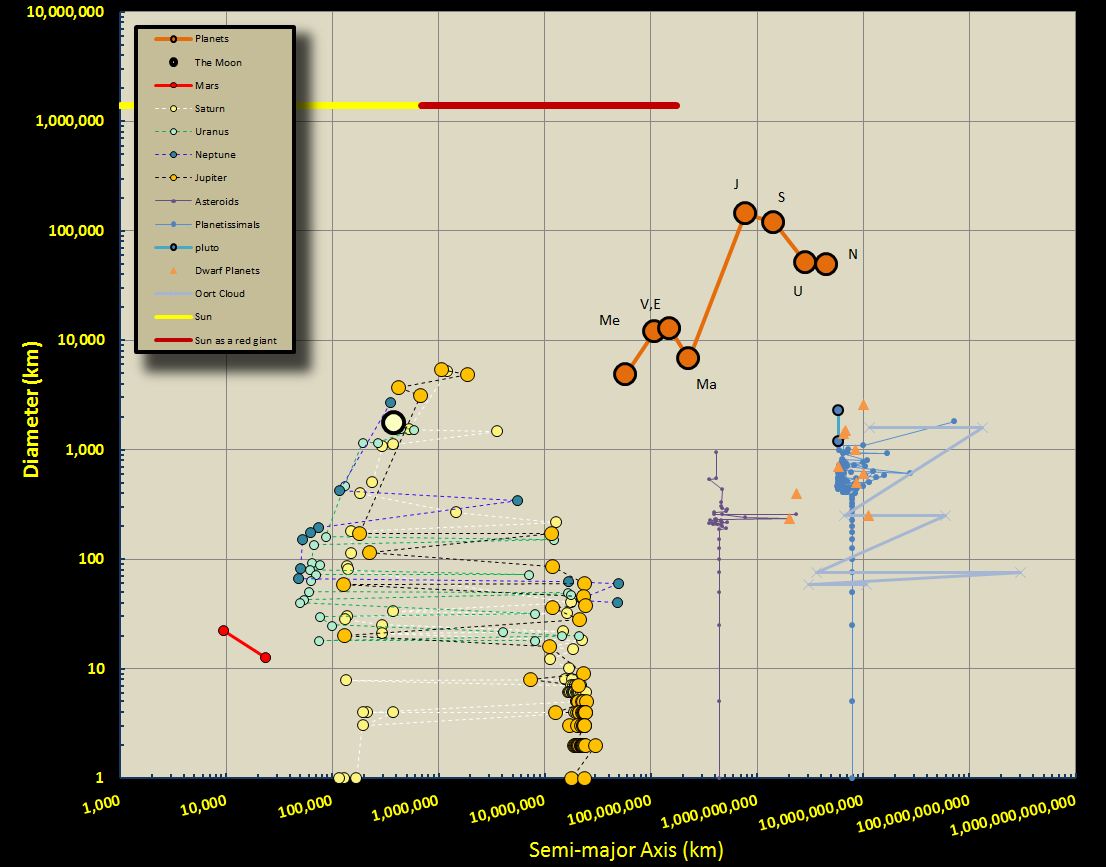
Some observations from this are:
- Mars has just two very small moons orbiting and very very low altitude
- Earth's Moon is very large given the size of the Earth and its position in the inner solar system
- From Jupiter to Neptune there is a logarithmic decay in planet size with orbital radius implying some degree of gravitational sorting of material in the early evolution of the solar nebula
- The moons of J, S, U and N follow a strikingly similar patterning on this graph with Jupiter having the most abundant spread due to it being well surveyed and containing many objects >1 km in diameter.
- These gas giants have moons that split into an inner ring of increasing size and outer ring of decreasing size, hence all the big moons are located at roughly 1M km radius.
- Three of these moons are larger than the smallest planet, Mercury. And many of these moons are larger than the largest planetesimals and dwarf planets in the outer reaches of the solar system.
- Pluto and Charon are clearly part of the dwarf planet/planetesimal cluster, hence their degradation from the planet category a decade ago.
- Scatter in the data beyond the orbit of Saturn indicates more observations are required.
- The Dwarf planets and asteroid belt show signs of interaction
- Oort Cloud and outer planetesimals show signs of interaction
- Due to its enormous surface area, the Oort Cloud probably represents a huge mass of material which is under-represented on this graph, especially considering objects <1 km in diameter.
2014-01-07
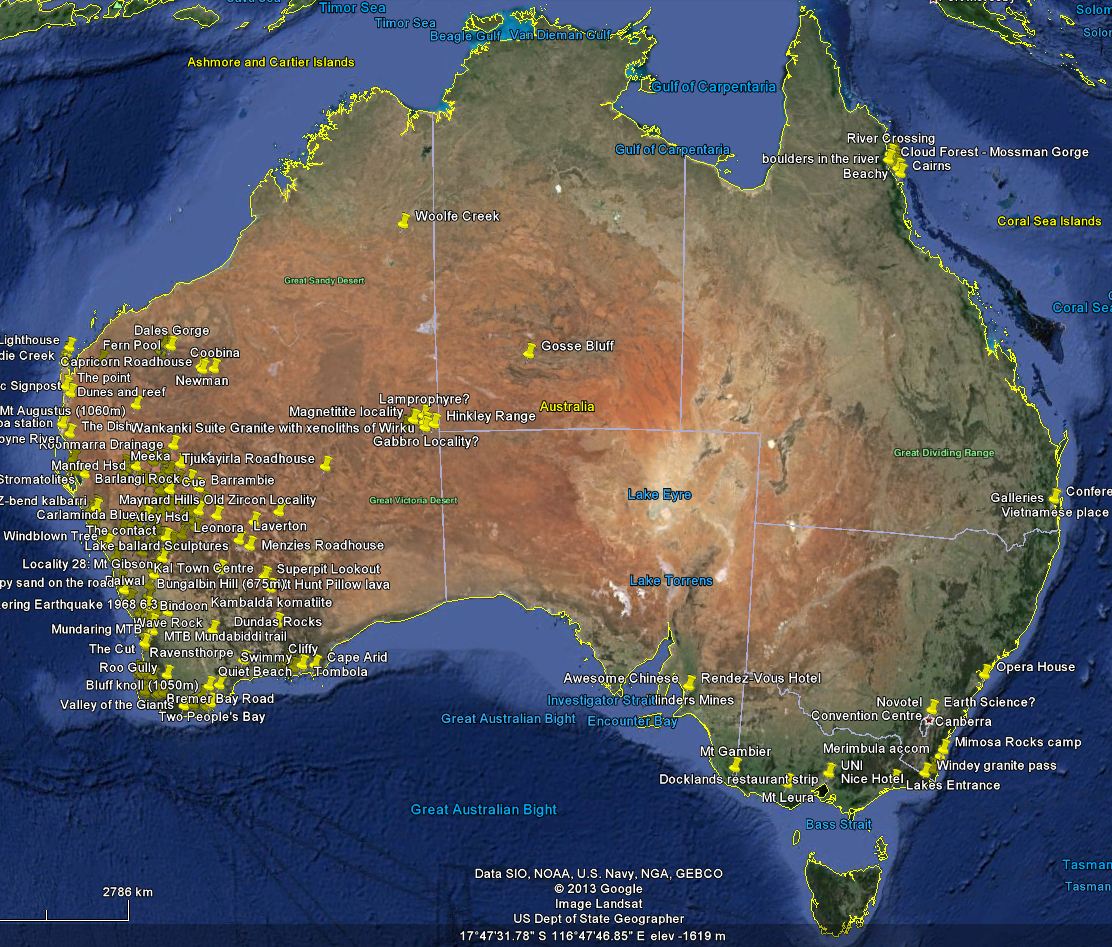
Australia coverage

2013-07-16
Reading: Mountains of the Mind - a thought dump
Having just finished the brilliant "Captain James Cook: A Biography" by Richard Hough, I am now most of the way through "Mountains of the Mind" by Robert MacFarlane. This combination has been immensely inspiring and enriching to me as a geologist, artist, antipodean dweller...in no particular order.
Cook sailed the seven seas on amazing voyages and saw things that no others had seen. Completion of the task of charting the coastlines of all the continents (except Antarctica but he was close and circumnavigated it for the first time). The first nourished global perspective if you like having gotten close to completing the map of the earth. As adaptable as our minds may be, it is this planetary situation that shapes us the most and its manifestations are nearly all that we interact with. This is something so funamental that we are obliged (perhaps) to have it reflected in it our own nature.
Then comes the Mountains of the Mind...a fantastic progression through the chapters is certainly to a geologist's liking. Cook managed the 2.5D conception and charting of the coastlines in the late 1700s. In the 1800s mountaineering and mapping gave us the third dimension as altitudes and contours were established in large swaths of the globe. During this century Hutton and Darwin gave us conception of great geological and evolutionary time, the until-then missing dimension.
The 1900s provided refinement of all these dimensions with advancement of the microscope, the telescope, radioactive dating, plate tectonics. The documantation of the full dimensionality of our landscapes is something like complete to a particular resolution with fine-scale details and active change being areas in need of constant attention. The Mountains of the Mind really takes the funtamentals of this 3-century-history and examines the way that this interaction between man and planet is ultimately the mirror for our own mind....the circumstance of our existence...the context for life...the interactions of the human condition with the physical. How can we communicate these conceptions about the land? Do we all have a non-verbalized (possibly subconscious) understanding of this that is deeply engrained?
The valleys and oceans of our thoughts can be tested, challenged, sculpted and crystallized against views into the magnificence of it all. Our knowledge of the earth is the fabulous backdrop to the further worlds of the imagination and provide all our metaphors for understanding. I am reminded of this connection very clearly in the words of many passages from Thus Spoke Zarathustra, talking of our feelings of being 'human...all too human' as we place ourselves in context on top of a mountain!
The Mountains of the Mind takes us on a journey through the history of mountaineering. From the evolution of thought from fear to awe to obligatory exploration. From the early conceptions of geological processes to great time. Ideas on ice(!). Human spirit, collaboration. Achieving undoubtedly great things. For me this was a great summary of how it is possibly to put the world together in ones mind independendly of education and socialization. I probably got a taste for this aged 9 on top of peaks of the lake district. It was the the longest day of the year and Dad took me up there to overnight on the cold craggy mountaintops where we huddled in rocky gully watching the sun rise through dramatic peaks at about 4am. Leaping forward to the present I'm still viewing things the same way.
Cook sailed the seven seas on amazing voyages and saw things that no others had seen. Completion of the task of charting the coastlines of all the continents (except Antarctica but he was close and circumnavigated it for the first time). The first nourished global perspective if you like having gotten close to completing the map of the earth. As adaptable as our minds may be, it is this planetary situation that shapes us the most and its manifestations are nearly all that we interact with. This is something so funamental that we are obliged (perhaps) to have it reflected in it our own nature.
Then comes the Mountains of the Mind...a fantastic progression through the chapters is certainly to a geologist's liking. Cook managed the 2.5D conception and charting of the coastlines in the late 1700s. In the 1800s mountaineering and mapping gave us the third dimension as altitudes and contours were established in large swaths of the globe. During this century Hutton and Darwin gave us conception of great geological and evolutionary time, the until-then missing dimension.
The 1900s provided refinement of all these dimensions with advancement of the microscope, the telescope, radioactive dating, plate tectonics. The documantation of the full dimensionality of our landscapes is something like complete to a particular resolution with fine-scale details and active change being areas in need of constant attention. The Mountains of the Mind really takes the funtamentals of this 3-century-history and examines the way that this interaction between man and planet is ultimately the mirror for our own mind....the circumstance of our existence...the context for life...the interactions of the human condition with the physical. How can we communicate these conceptions about the land? Do we all have a non-verbalized (possibly subconscious) understanding of this that is deeply engrained?
The valleys and oceans of our thoughts can be tested, challenged, sculpted and crystallized against views into the magnificence of it all. Our knowledge of the earth is the fabulous backdrop to the further worlds of the imagination and provide all our metaphors for understanding. I am reminded of this connection very clearly in the words of many passages from Thus Spoke Zarathustra, talking of our feelings of being 'human...all too human' as we place ourselves in context on top of a mountain!
The Mountains of the Mind takes us on a journey through the history of mountaineering. From the evolution of thought from fear to awe to obligatory exploration. From the early conceptions of geological processes to great time. Ideas on ice(!). Human spirit, collaboration. Achieving undoubtedly great things. For me this was a great summary of how it is possibly to put the world together in ones mind independendly of education and socialization. I probably got a taste for this aged 9 on top of peaks of the lake district. It was the the longest day of the year and Dad took me up there to overnight on the cold craggy mountaintops where we huddled in rocky gully watching the sun rise through dramatic peaks at about 4am. Leaping forward to the present I'm still viewing things the same way.

Subscribe to:
Posts (Atom)